

Contemporary Past: counter strategies for greenwashing
- Informacija
- Paskelbta: 2013 gegužės 07, Antradienis 16:35
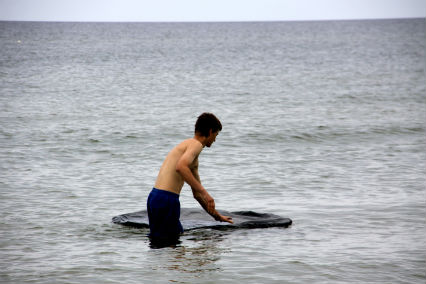
Vytautas Tautkevičius installing his work "Oil Spots" in the Baltic sea, 2011 / Photo by J.Jarulytė
During the fourth and the last Contemporary Past students and tutors will investigate artistic projects and cultural initiatives dealing with ecology and environment related topics from the critical vantage point of tracking the concept/idea of sustainability, its socio-economic and political contexts.
Nida art Colony’s location, where the program takes place becomes a significant aspect for this program – in the 19th century artists clustered in Nida due to its extraordinary scenery – sea, lagoon, sand, very special light – and the romantics of what we might call the “sustainable” life of an „ordinary“ fishing village. At that time, artists, mostly painters, studied nature: they painted en plein-air, sketched and tried to master the art of representing reality. The skills they learnt studying nature in Nida served them later in creating multifaceted and hence qualitatively more valuable art works.
Nowadays the relationship between artists and nature is fundamentally re-examined and the interstices between art and activism reformulated. Artists are exploring new fields of communication incorporating both, the virtual and the public sphere. Almost exclusively in collaborative form, artist have managed to reconfigure their role, relating artistic practice to engage with and participate on the local, communal and global level. Occasionally labelled as „green“, artistic practice emphasizes matters of environmental protection, but also investigates the commercial exploitation of green trends in consumption and production, marketing and foremost and omnipresent, technology. In a more intertwined and ambivalent relationship of artistic and cultural production to commercially fuelled activities, certain art and design projects have been subject to greenwashing itself.
The intensive summer course Counter Strategies for Greenwashing will critically examine ideas and examples of eco-art and sustainability-related projects. Participants will:
- analyze specific art works and actions by art activists,
- get deeper into several local environmental case studies,
- strategize ways to redefine an eco-friendly relationship between art(ist) and nature,
- reflect upon the current infrastructure and protocols of cultural production, (re-)presentation and reception;
- offer their own response to the researched topic by creating and presenting their own art works/drafts.
Contemporary Past consists of workshops, theoretical lectures, brainstorming sessions, field trips, film screenings, independent research and art work production. Roughly the first week is devoted to workshops, lectures, discussions and field trips; the second – to individual research and art work production. Public review and discussion of created works will take place on the final weekend.
Contemporary Past will take place on 10-24th June, 2013 in Nida Art Colony of Vilnius Academy of Arts.
More information on Contemporary Past - HERE.